
Historic Turning Point in the Global Electricity Market: Renewables Cover Demand Growth in 2025 and Surpass Coal
London (UK) - The global market for renewable energy continued to grow in 2025. This is shown by a recent study from the think tank Ember. According to the study, the entire increase in global electricity demand was, for the first time, fully met by renewable energy. In addition, another milestone was reached.
Solar energy and wind power in particular drove this transformation, while coal use declined noticeably in China and India and renewables increased significantly. The report thus underscores a structural shift: the global energy system is increasingly moving away from fossil fuels toward electrified, renewable structures. Solar energy in particular is becoming the central driver of growth in a new energy order.
Solar boom covers entire additional electricity demand in 2025 – fossil generation stagnates
The global expansion of renewable energy reached a significant turning point in 2025. According to data from Ember, all additional global electricity demand was met entirely by clean energy for the first time. As a result, electricity generation from fossil sources remained nearly unchanged.
The main driver of this development is solar energy. In this sector, global electricity production rose by 636 terawatt-hours (TWh) in 2025, representing a 30 percent increase compared to the previous year. Since 2015, solar power generation has increased more than tenfold and roughly doubles every three years.
Together with growth in other clean energy sources, the solar boom helped renewables meet the entire increase in global electricity demand. Solar energy alone accounted for three-quarters (75%) of the increase, while solar and wind together covered almost all of it (99%). Overall, clean electricity generation rose by 887 TWh, slightly exceeding demand growth of 849 TWh. As a result, electricity generation from fossil fuels fell by 0.2%, making 2025 only the fifth year this century without growth in fossil power generation.
“We have firmly entered the era of clean growth. Clean energy is now scaling fast enough to absorb rising global electricity demand, keeping fossil generation flat before its inevitable decline,” said Aditya Lolla, CEO of Ember. “Solar has been the dominant driver of change in the global power system. Along with battery storage, it is opening a path to fast-scaling, round-the-clock clean power,” he added.
Battery storage becomes increasingly important for the energy system
The expansion of storage capacity is becoming increasingly important. According to Ember, enough battery capacity was installed in 2025 to shift 14 percent of the additionally generated solar energy in time.
Pioneer countries such as Chile and Australia are already installing battery storage systems large enough to make a significant share of solar energy usable outside daylight hours. This demonstrates how storage solutions improve system flexibility and enable a higher share of solar energy in the electricity mix.
Renewables surpass coal in the global electricity mix for the first time
In addition to covering demand growth, 2025 also marks another structural break, as renewable energy has overtaken coal-fired power generation. While the share of renewables in global electricity generation rose to 34 percent, coal generation fell by 63 TWh during the reporting year, dropping to a 33 percent share. Renewable energy has thus surpassed global coal power for the first time in over 100 years.
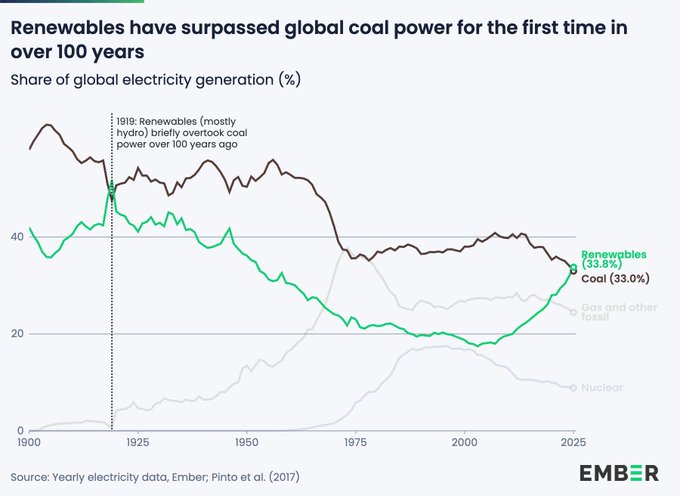
This structural shift is particularly evident in China and India, the two largest growth markets of recent decades. In China, fossil-based electricity generation fell by 56 TWh, as renewable expansion covered the entire increase in demand. India recorded a decline of 52 TWh in fossil energy, supported by strong growth in solar and wind power as well as high hydropower generation.
China drives massive expansion of non-fossil energy
China also plans to significantly expand non-fossil energy in the coming years and further accelerate the transformation of its energy system. According to the National Development and Reform Commission (NDRC), the supply of non-fossil energy sources is expected to rise significantly by 2030 compared to 2025 and even double by 2035.
This expansion is part of the 15th Five-Year Plan and aims to build a new energy system increasingly based on renewable and low-carbon sources. In addition to the massive expansion of centralized and decentralized renewable projects, large infrastructure projects such as new hydropower and energy hubs are intended to strengthen supply capacity.
At the same time, the integration of renewable energy into the power grid is to be improved and the share of non-fossil energy in consumption significantly increased. Fossil fuels will be gradually replaced, but will remain in the system as a security and stability component. The government is also focusing on accelerating electrification in key sectors as well as on technological innovations such as energy storage, green hydrogen, and new grid technologies.
Source: IWR Online, Apr 04 2026